Blog
Discover Stanford in the Vale UK: A Hidden Gem in Oxfordshire


Introduction
When people think of the English countryside, they imagine rolling fields, charming cottages, and a warm community spirit. That picture perfectly describes Stanford in the Vale UK, a beautiful village tucked away in Oxfordshire. With its deep history, stunning landscapes, and vibrant local life, this hidden gem offers something for everyone – whether you’re a traveler, a history lover, or someone seeking a peaceful place to live.
In this guide, we’ll dive into everything that makes Stanford in the Vale UK so special. From its rich heritage and traditional charm to its modern amenities and close-knit community, you’ll discover why this village continues to attract visitors and residents alike. Let’s take a walk through its winding streets and explore its timeless beauty.
📍 Where is Stanford in the Vale UK?
Stanford in the Vale is a civil parish and village located in the Vale of White Horse district of Oxfordshire, England. Positioned just a few miles from Wantage and Faringdon, it enjoys a prime location that blends countryside tranquility with easy access to towns and cities. Oxford, the famous university city, is only a short drive away, making it a convenient hub for both commuters and explorers.
🏡 History of Stanford in the Vale UK
Early Roots
The history of Stanford in the Vale UK stretches back centuries. The name itself comes from “stone ford,” reflecting its origins near a crossing on the River Ock. Archaeological findings suggest settlements here date as far back as the Roman and Saxon periods.
Medieval Times
During the medieval era, Stanford in the Vale was part of the estates connected to nearby monasteries. Its parish church, St Denys, built in the 12th century, still stands proudly as a symbol of the village’s heritage.
A Growing Community
Over time, the village grew into a thriving agricultural hub. Today, it maintains that rural essence but with the comforts of modern life. Its balance of old and new makes it unique among Oxfordshire’s many villages.
🌿 Countryside Beauty and Outdoor Life
The surrounding countryside of Stanford in the Vale is breathtaking. Rolling hills, green meadows, and peaceful walking paths make it a dream for nature lovers.
- Walking Trails: Enjoy scenic footpaths leading to neighboring villages.
- Cycling Routes: The area is ideal for cycling, with safe country lanes.
- Wildlife: Birds, deer, and countryside flora thrive here.
The village is part of the Vale of White Horse, an area famous for the Uffington White Horse chalk figure, only a short trip away.
🛍️ Local Life and Amenities
Despite its size, Stanford in the Vale UK is far from isolated. It boasts all the essentials and more:
- Shops & Services: A convenience store, post office, and local businesses.
- Education: The village has its own primary school, highly regarded in the area.
- Healthcare: Access to nearby clinics and hospitals in Wantage and Faringdon.
- Dining & Pubs: Traditional pubs like the Horse & Jockey serve hearty meals and local ales.
The community hall and local organizations host activities for all ages, making life here lively and connected.
🎉 Events and Community Spirit
One of the highlights of Stanford in the Vale is its active community life.
- Village Fêtes: Traditional English fairs with stalls, games, and food.
- Music & Arts: Local groups often host performances and exhibitions.
- Sports Clubs: Football, cricket, and other recreational activities bring people together.
This spirit of togetherness makes new residents feel welcome immediately.
🏰 Nearby Attractions
Living in or visiting Stanford in the Vale UK also means being close to some incredible attractions:
- Uffington White Horse & Dragon Hill – Ancient landmarks with stunning views.
- Wantage – Birthplace of King Alfred the Great, rich in history.
- Faringdon – Famous for Faringdon Folly Tower and its quirky charm.
- Oxford – Just a short drive away, with its world-famous university and architecture.
🚗 Transport and Connectivity
Stanford in the Vale may feel tucked away, but it is well connected:
- Road Access: Good links to the A420 (Oxford to Swindon).
- Rail: Nearby Didcot Parkway provides direct trains to London.
- Air Travel: Heathrow and Bristol airports are within reasonable driving distance.
This makes the village ideal for commuters who want countryside peace without losing city access.
🌟 Living in Stanford in the Vale UK
What makes this village so desirable?
- Peaceful lifestyle without isolation.
- Affordable homes compared to city living.
- Rich history and character.
- Strong sense of community.
Whether you’re raising a family, seeking retirement tranquility, or just craving a slower pace of life, this Oxfordshire treasure offers it all.
Conclusion
Stanford in the Vale UK is more than just a village – it’s a lifestyle. With its charming history, countryside beauty, and thriving community, it captures the best of rural England while staying connected to modern life. It’s a place where tradition meets today, and where every visitor or resident feels at home.
If you’re searching for an authentic English village experience, whether to visit or to live, Stanford in the Vale UK is the perfect choice. Its heartwarming atmosphere, local culture, and easy connections make it a true hidden gem waiting to be explored.
❓ FAQs about Stanford in the Vale UK
Q1: What is Stanford in the Vale UK known for?
It’s known for its charming countryside setting, historic St Denys Church, strong community spirit, and proximity to attractions like the Uffington White Horse.
Q2: Is Stanford in the Vale a good place to live?
Yes! It offers a peaceful lifestyle, great local amenities, and a welcoming community while being close to Oxford and other towns.
Q3: Are there schools in Stanford in the Vale UK?
Yes, the village has a primary school, and there are several secondary schools in the nearby towns.
Q4: How do I travel to Stanford in the Vale?
By car via the A420, by train through Didcot Parkway, or by bus services connecting nearby towns.
Q5: What attractions are near Stanford in the Vale UK?
Nearby sites include Wantage, Faringdon, the Uffington White Horse, and Oxford.

Partnering with a premier digital marketing agency in London is the absolute smartest move an e-commerce entrepreneur can make to transform a quiet website into a roaring, highly profitable global brand. The digital world is expanding at a breakneck speed, and trying to stand out in the middle of this massive virtual high street is a wild, exhausting adventure. One day your shop is cruising smoothly, and the next day internet algorithms shift completely, leaving your gorgeous products hidden away where nobody can find them. For hard working store owners who simply want to share their creative goods with the world, keeping up with every single tech puzzle is a massive recipe for a midnight headache. That is exactly why bringing in local performance experts to steer the ship alterations the entire game, allowing you to breathe a massive sigh of happy relief.
A visionary digital marketing agency in London operates as your ultimate navigational compass through the wild, unpredictable storms of the internet landscape. They take all those confusing data metrics and magically reshape them into real, long term human connections that drive steady sales straight to your digital checkout. Instead of spending your precious, exhausting nights guessing which advertising campaign will work, you hand over the reins to a dedicated squad who lives and breathes digital growth. Let’s look at why having a top tier london digital marketing agency at your side is an absolute necessity for surviving and truly dominating the future of retail.
Crafting Your Ultimate Digital Shopfront
When a curious customer clicks on your shop link, your landing page has a few brief seconds to make an unforgettable first impression. If the layout feels confusing or slow, shoppers will skip away to a competitor faster than you can pour a hot cup of tea!
The Art of Breathtaking Design
Investing in premium website design in London is the literal foundation of your entire retail empire, turning casual window shoppers into passionate brand fans. A beautiful layout acts like a welcoming physical boutique, guiding the eyes effortlessly toward your finest products while keeping the checkout process completely smooth. Experts ensure that your buttons are incredibly satisfying to click, your images look dazzlingly clear, and the whole system functions beautifully on mobile phone screens. When you secure high quality website design in London, your brand naturally builds instant trust and looks incredibly professional.
Building Foundations for Lasting Growth
The online shop needs to function like a well oiled machine beneath those gorgeous colors and fonts. By collaborating with a skilled digital marketing company in London, your eCommerce platform receives the heavy duty optimization it needs to handle thousands of eager visitors simultaneously. They clean up backend code, arrange smooth navigation filters, and establish secure gateways so customers feel totally safe typing in their credit card details. This complete operational excellence is a major part of the tailored marketing services in London that successful brands rely on to future proof their operations for 2027 and far beyond.
Mastering the Power of Social Commerce
Modern shoppers do not just stare at search bars; they gather all their style inspiration, product recommendations, and lifestyle goals from their daily social feeds. To capture their hearts, your store must become a vibrant, living character in their scrolling routines.
Brilliant Social Media Strategies
Executing high end social media marketing in London ensures your products stay firmly under the spotlight where they belong. Specialists help tell your unique brand story through rich visual content, making your goods look like a natural choice for an elegant, modern lifestyle. From showcasing minimalist vegan leather accessories to high end canvas bags, professional social media management keeps your messaging incredibly consistent and highly engaging. It removes the stressful burden of creating daily posts off your shoulders, letting true creative artists build an active, cheering community around your business.
Driving Sales with Precision Advertising
Organic reach is a wonderful bonus, but running hyper targeted social media advertising campaigns is the real engine that drives rapid revenue growth. Experts manage your budgets with extreme care, placing your eye catching banners directly in front of the exact demographics who are already looking to buy. Whether you require advanced meta ads management to capture trendy Instagram shoppers or continuous performance tracking, the pros optimize every single pound spent. This masterful control over social media advertising ensures your store bypasses generic audiences, speaking directly to those eco conscious or style loving individuals who appreciate high end practicality.
Dominating the High Traffic Channels
If you want your store to thrive over the long term, you simply cannot rely on just one single traffic stream. You need a powerful web of visibility pulling in customers from every corner of the vast internet universe.
Climbing the Search Rankings
A gorgeous shop is completely pointless if it stays buried on page ten of the search results where nobody ever looks. Partnering with a premier digital marketing agency in London means your product pages undergo a complete transformation to fall in love with search engines. Utilizing world class seo services in london allows your business to naturally climb the search mountain, positioning your items right at the top when buyers hunt for modern home luxuries or durable IT organizers. True experts optimize your keywords and fix structural links, delivering a massive wave of free organic traffic straight to your digital door.
Winning with Instant Visibility
While search optimization works beautifully over time, setting up advanced google ads management provides that thrilling explosion of immediate visibility and sales. Paid search placement ensures your store shows up instantly the second high intent shoppers look for premium furniture or elite flooring solutions. A top tier digital agency in London tracks these active search terms continuously, adjusting bids in real time to capture every single profitable click. Blending this smart paid approach with long term organic strategies is why a comprehensive london digital marketing agency is an absolute lifesaver for growing companies.
Navigating the Competitive London Market with Mayfair Digital Agency
In a massive metropolis absolutely bursting with generic corporate firms, finding an elite partner that treats your dream like their own baby is a rare blessing. Mayfair Digital Agency has built an absolutely stellar reputation across the capital because they completely refuse to hide behind confusing tech jargon or produce slide decks full of fake hype.
The Supportive Touch of Mayfair Digital Agency
What makes Mayfair Digital Agency feel so refreshingly human is their deep commitment to real, honest, and collaborative partnerships. They sit down with store owners over a proper coffee at Somerset House, listen closely to their daily struggles, and map out a simple, clear path for explosive growth. When you work with Mayfair Digital Agency, you get access to a senior team that integrates search power, paid ads, and social media into one unified plan. It brings a profound sense of inner relief knowing that a world class digital marketing agency in London has its hands firmly on the steering wheel of your brand authority.
Maximizing Every Marketing Pound
A major mistake that many lonely business owners make is scattering their budgets across random freelance platforms without a clear, master strategy. Mayfair Digital Agency stops that financial waste entirely by providing result driven marketing services in London that focus heavily on return on investment rather than silly vanity metrics. They ensure your content fuels your social channels, your social authority strengthens your ads, and your optimized code makes your google ads management incredibly cost effective. Letting a premium digital agency in London like theirs handle the heavy technical lifting gives you the absolute freedom to focus entirely on product perfection.
Securing Your Long Term Digital Longevity
As we march forward into the exciting digital future, the e-commerce landscape will only become more crowded, noisy, and fiercely competitive. Choosing to work with a premier digital marketing agency in London is no longer just a fancy luxury for massive corporations; it is a vital tool for basic marketplace longevity.
Embracing Comprehensive Campaign Control
A true digital marketing company in London keeps an analytical eye on the horizon, adapting your store to changing consumer behaviors before your competitors even know what happened. They fine-tune your meta ads management to stay efficient, update your copy to maintain high search rankings, and breathe fresh life into your social media management campaigns. This continuous, loving maintenance guarantees your store functions like a powerhouse data center, running smoothly and converting clicks into cash while you sleep peacefully at night. It transforms the scary online wilderness into an incredibly exciting playground full of endless financial opportunities.
Your Invitation to True Digital Success
In the final end, taking the brave, decisive leap to invest in a premium digital marketing agency in London is the greatest gift you will ever give to your business. You simply do not have to struggle through the confusing maze of online retail all by yourself! From the initial artistic sketches of your website layout to the triumphant long term victories achieved on the search pages, every milestone becomes a joyful celebration with the pros beside you. Let the specialists handle the confusing codes, the algorithm updates, and the ad bids so you will finally reclaim your time and energy. Reach out to an elite partner like Mayfair Digital Agency today, and get ready to watch your online store blossom beautifully into the dominant, legendary brand it is truly meant to be!

La verificación de identidad ya no es opcional en España
La verificación de identidad dejó de ser un trámite anecdótico. En España, cualquier operador con licencia de la Dirección General de Ordenación del Juego (DGOJ) está obligado a comprobar que el usuario es mayor de 18 años y titular real de los fondos antes de permitir retiradas. Eso, en la práctica, significa que el 100% de los casinos regulados en España exige verificar la cuenta antes del primer cobro. Puede encontrar más detalles en casino deposito skrill.
El cambio normativo de este año refuerza ese control: los plazos de comprobación se han acortado y las retiradas sin verificación previa quedan directamente bloqueadas. Ya no basta con depositar y jugar; el operador debe validar el DNI o NIE y contrastar los datos bancarios antes de liberar ganancias.
Para el jugador esto se traduce en un proceso más ágil pero ineludible. La mayoría de las plataformas completan la validación en menos de 24 horas si la documentación es correcta, aunque la ley permite hasta 72 horas en casos de revisión manual.
Qué implica jugar en un casino sin verificación
Existe la tentación de buscar plataformas que prometan retiradas sin verificación. Conviene ser claro: en España esas ofertas suelen proceder de operadores sin licencia DGOJ, lo que deja al jugador sin protección legal, sin canal de reclamación ante la DGOJ y sin garantía sobre sus fondos.
Los casinos regulados aplican la verificación también como medida antimoney laundering. Según datos del sector, alrededor del 85% de las incidencias en retiradas se resuelven precisamente cuando el usuario aporta la documentación requerida. El mensaje es doble: verificar es rápido y es la única vía segura para cobrar.
La alternativa , operadores sin licencia, implica riesgos concretos: cuentas bloqueadas sin explicación, límites de retirada abusivos y cero cobertura ante el Servicio de Reclamaciones de la DGOJ.
Buenas prácticas para verificar sin fricciones
Tener la documentación lista ahorra tiempo. Antes de registrarte, asegúrate de que el nombre de tu cuenta bancaria coincide exactamente con el del DNI o NIE y que la imagen del documento se ve con nitidez, sin reflejos ni bordes cortados.
- Usa un documento en vigor: DNI, NIE o pasaporte aceptado por el operador.
- Comprueba que el titular de la tarjeta o cuenta coincide con tu identidad.
- Realiza la verificación al registrarte, no al solicitar la retirada.
- Guarda el justificante de envío de documentación por si hay incidencias.
En definitiva, el casino sin verificación es hoy una ficción en el mercado regulado español. Comprender qué cambia este año , plazos más cortos, bloqueo de retiradas sin validación y mayor control de titularidad, te permite operar con tranquilidad y evitar sorpresas en el momento de cobrar.
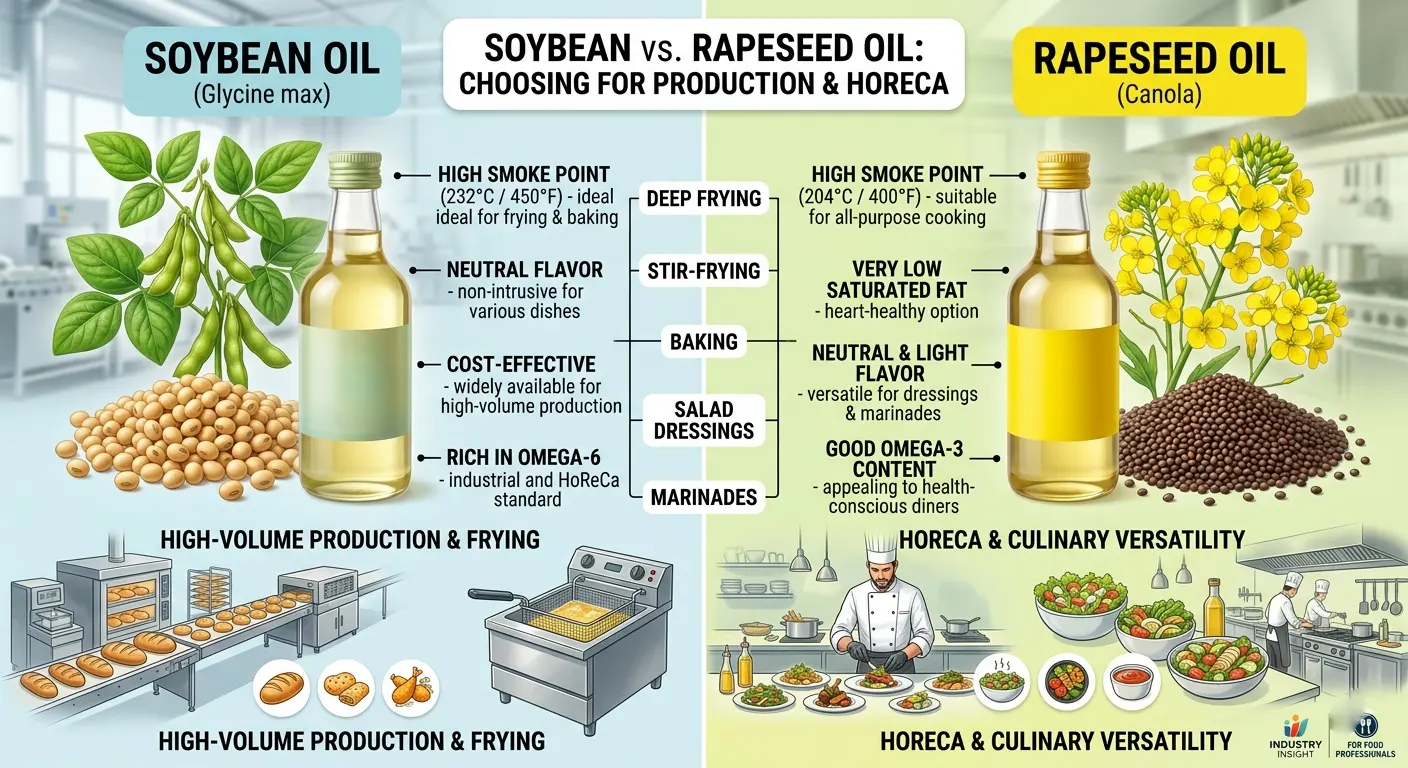
For food producers, restaurants, hotels and catering operators, oil is not just a basic commodity. It influences frying life, shelf stability, taste, nutritional positioning, labeling, waste and final food cost. Soybean oil and rapeseed oil are both neutral vegetable oils, but they are not identical in performance. The right choice depends on the process: cold sauces, baking, ready meals, shallow frying and intensive deep frying all place different demands on fat.
First, terminology matters. Food-grade rapeseed oil is usually low-erucic rapeseed oil, widely known as canola oil in international trade. Codex identifies rapeseed oil as oil from Brassica species and separately defines low-erucic rapeseed oil, including canola oil, as oil from low-erucic varieties. Soybean oil is derived from soya beans, Glycine max. This distinction is important for specifications, labeling and export documentation.
Soybean oil is usually valued for availability, competitive pricing and a clean, neutral flavor. In production it works well in mayonnaise, sauces, dressings, marinades, ready meals, bakery items and snack formulations where the oil should not dominate the recipe. It is convenient for large batches because global supply chains are mature and bulk procurement is often easier than with more specialized oils. For manufacturers working under strict cost targets, standard refined soybean oil can be a rational choice.
Its main limitation is oxidation stability. Conventional soybean oil has a high share of polyunsaturated fatty acids, especially linoleic acid. These fatty acids are nutritionally useful, but they are more sensitive to oxygen, light and heat. In practice, this can mean faster development of rancid notes, darker oil, foaming, sticky fryer residues and shorter frying life. For cold sauces or products with fast turnover, this may be acceptable. For long shelf-life snacks, transparent packaging or continuous frying, it becomes a serious technical factor.
Rapeseed oil has a different strength. It is generally richer in monounsaturated fat, especially oleic acid, and lower in saturated fat than many common edible oils. This gives it a strong nutritional image and typically better heat behavior than oils dominated by polyunsaturated fats. In HoReCa, refined rapeseed oil is popular because it is mild, light in color and flexible. It can be used for sautéing, roasting, baking, dressings, marinades, mayonnaise-style sauces and many frying tasks without changing the flavor profile of the dish.
For frying, businesses should not rely on smoke point alone. Smoke point depends on refining quality, free fatty acids, water, food residues, filtration habits and how long the oil has already been used. A more useful criterion is real oxidative and thermal stability: how slowly the oil forms off-flavors, foam, dark color and total polar compounds during service. Since oleic acid is more stable than linoleic and linolenic acids, high-oleic oils are especially attractive for heavy frying. This applies to both categories: high-oleic soybean oil performs better than conventional soybean oil, and high-oleic rapeseed oil improves durability compared with standard rapeseed oil.
In HoReCa, rapeseed oil is often the safer default when one oil must cover many tasks. It is suitable for restaurants and catering operations that need neutral taste, good menu flexibility and a healthier “house oil” story. It is especially useful for salads, vegetable roasting, pan frying, sauces, bakery glazes and general kitchen use. If the kitchen runs fryers for many hours a day, the best option is refined high-oleic rapeseed oil or a dedicated frying blend rather than ordinary multipurpose oil.
Soybean oil can still be the better option in industrial production. When the oil is used in controlled conditions, protected from oxygen, supported by antioxidants, packed correctly or consumed quickly, it can deliver excellent cost efficiency. It is also practical where the local market is familiar with soybean oil and allergen labeling is not a commercial barrier. For price-sensitive sauces, fillings, ready meals and bakery products, soybean oil can reduce ingredient cost without compromising taste, provided the process does not expose it to excessive heat stress.
Nutrition and marketing also matter. Rapeseed oil is easier to position as a “better-fat” choice because of its low saturated fat and higher monounsaturated fat content. It also contains plant omega-3 in the form of alpha-linolenic acid. Soybean oil also provides essential fatty acids, including linoleic acid and some alpha-linolenic acid, but its higher omega-6 profile may require more careful communication in wellness-focused product lines. For premium HoReCa concepts or retail products with a health-oriented message, rapeseed oil usually fits the brand story more naturally.
Taste is rarely decisive when both oils are refined, because both are broadly neutral. However, cold-pressed rapeseed oil is a separate product: it can have a nutty, seed-like flavor and deeper color. That can be attractive in salads, dips and artisanal bakery products, but it is not a universal substitute for refined oil. In professional purchasing, the specification should clearly state whether the oil is refined, cold-pressed, deodorized, high-oleic, non-GMO, low-erucic or designed for frying.
The practical recommendation is straightforward. Choose refined rapeseed oil when you need one versatile oil for HoReCa, better nutritional positioning, balanced heat performance and neutral flavor. Choose conventional soybean oil when cost, availability and bulk formulation efficiency are the main priorities, especially in cold or moderate-heat production. Choose high-oleic soybean or high-oleic rapeseed when frying life, shelf stability and clean flavor over time are critical. For fryers, always test the oil in the real process: same equipment, temperature, product load, filtration routine and replacement schedule.
In conclusion, there is no universal winner. Rapeseed oil is usually the stronger all-round choice for restaurants, hotels and catering because it combines versatility, neutral taste and a stronger nutrition story. Soybean oil is often the economical industrial ingredient, especially in high-volume recipes where heat stress is limited. For intensive frying and long shelf-life production, the real winner is the high-oleic version or a professionally designed frying blend. The best decision should be based not only on price per liter, but on cost per finished portion, oil turnover, waste, flavor stability, labeling requirements and the promise your brand makes to customers.

Corteiz Air Max 95: Iconic Sneakers and Urban Streetwear Style

Madhappy The Brand Redefining Modern Streetwear and Positive Fashion

Full Time Driver Service Dubai Own Sponsorship vs Outsourced Service

Top 7 US Cities Digital Nomads Are Choosing as Their Base in 2026

Byrutor Explained: Risks, Uses, and Digital Trends Guide